
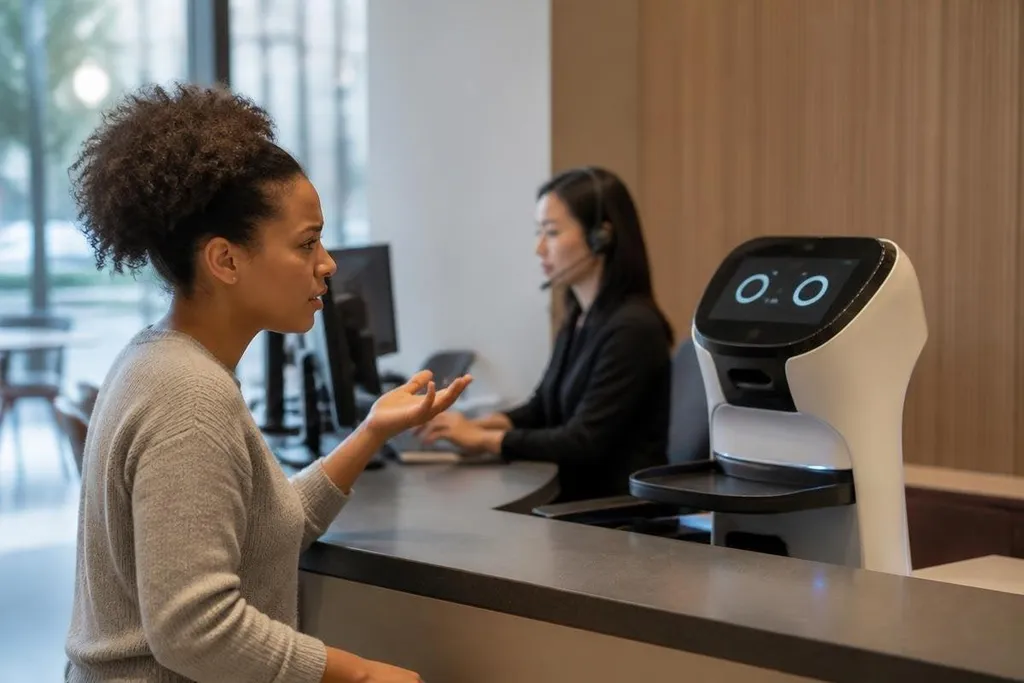
Someone may prefer a person for a complaint, then choose a robot for a fast, routine task. The useful answer depends on what the customer needs, what can go wrong, and how much contact the service requires.
Quick read
- Routine tasks suit robots when speed and consistency matter.
- Sensitive decisions still need a clear human route.
- Customers judge the whole service, not the machine alone.
That last point matters because a robot can work well and still leave customers unhappy if nobody explains its limits. A human can also provide poor service when the process is slow, unclear, or hard to access.
Where robots fit
Robots work best when the task has a clear start, a clear result, and little need for judgment. For routine jobs, customers may value quick answers over conversation, such as checking an order status, collecting a parcel, or using a self-service kiosk.
The machine also needs a defined way to hand the task to a person.
When the robot cannot understand a request, finds a damaged item, or meets a case outside its rules, the customer should know what happens next. That handoff is part of the service, not a spare feature.
Physical robots add another layer. A delivery robot, reception robot, or service arm must move safely around people and make its actions easy to read. Customers need to know where to stand, what the robot is doing, and how to stop or report a problem.
Where people still matter
Human service carries more weight when the customer feels uncertain, upset, or exposed. A billing dispute, medical question, insurance claim, or serious product fault can need judgment and care that a fixed script cannot give.
People also help when the customer’s request is unusual. They can ask a follow-up question, spot missing context, and change the path through the service. That flexibility can prevent a small error from becoming a long complaint.
The choice does not have to place every task on one side. A robot can collect basic details before a person takes over. It can also pass a record of the earlier steps, so the customer does not have to repeat the same story.
Companies deciding where automation belongs can use reporting on customer-facing robots to compare the machines, firms, and settings behind these tasks. A polished demo shows how a robot behaves in one chosen moment. Customer preference forms across the full interaction, including the handoff to a person.
What customers are really judging
Customers rarely judge a robot by its shape or voice alone. They judge the time it takes, the clarity of its instructions, the result it gives, and the path available when something fails.
A human worker faces the same test. A friendly greeting cannot repair a payment error that takes three calls to fix. A robot voice cannot rescue a process that hides the option to speak with a person.
Trust also depends on disclosure. Customers should know when they are dealing with a robot, what information it uses, and when a person will review the case. Clear notice gives people a fair choice and sets a reasonable limit on what the system can do.
I’d keep humans responsible for decisions that affect money, safety, health, or access, even when robots handle the early steps.
A decision guide for service teams
Use these checks before assigning a customer task to a robot:
- Define the task: write the exact result the customer needs and the situations that sit outside the robot’s rules.
- Measure the handoff: count how many steps a customer takes to reach a person when the first route fails.
- Set a human review: place a trained worker behind decisions involving safety, health, money, privacy, or denial of service.
- Test plain instructions: ask people unfamiliar with the system to complete the task without help, then record where they stop.
- Show the limit: tell customers what the robot can do, what it cannot do, and how to report an error.
- Check the recovery: test a wrong answer, a failed payment, a damaged item, and an unclear request before launch.
These checks turn a broad preference question into a service design question. They also give a company something better than a vote between “human” and “robot”: evidence about which parts of the interaction work.
Customers will prefer robots for tasks that feel quick, clear, and low-risk. They will keep asking for people when judgment, responsibility, or trust matters more than speed.